How institutions get uranium exposure
Institutions invest in uranium through mining equities, ETFs, physical trusts, futures, or physical uranium. How each route works and how they differ.
Institutions get uranium exposure through several routes, and the routes are not equivalent. Each differs in what you own, how closely it tracks the uranium price, and whether it can be redeemed for physical uranium. This is an educational overview of the main routes, not investment advice.
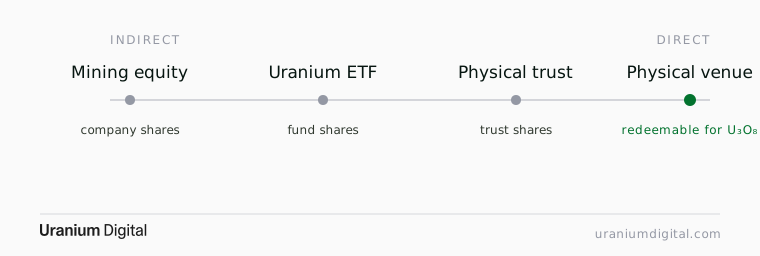
Ways institutions invest in uranium
- Mining equities. Shares in uranium producers give exposure to the uranium price with added company risk from operations, costs, management, and equity-market beta. A producer's share price does not track the uranium price one-for-one.
- Uranium ETFs. Most uranium ETFs hold a basket of mining equities, and some also hold units of physical uranium trusts. They track the mining sector more closely than the uranium price.
- Physical uranium trusts. A closed-end trust holds physical U₃O₈ and issues units. The units can trade at a premium or discount to the value of the uranium held, and holders generally cannot redeem them for physical uranium.
- Futures. Exchange-listed uranium futures, such as the UxC U₃O₈ contract listed by CME Group, are cash-settled and trade thinly. Few institutions use them as a primary route.
- Physical uranium. A redeemable claim on physical U₃O₈ gives the most direct exposure. It is ownership of the commodity, tradable on-screen and redeemable for physical delivery.
What separates the routes
The routes differ on the points that matter to an allocator.
| Route | What you own | Tracks the uranium price | Redeemable for uranium |
|---|---|---|---|
| Mining equities | Company shares | Loosely | No |
| Uranium ETF | Fund shares | Loosely | No |
| Physical trust | Trust units | Closely, at a premium or discount | Generally no |
| Futures | A cash-settled contract | Closely | No |
| Physical uranium | A redeemable claim on U₃O₈ | Directly | Yes |
For a closer comparison of the physical routes, see uranium ETFs, physical trusts, and physical uranium.
What to compare before choosing a route
Beyond what each route holds, allocators typically weigh five practical points.
- Tracking. How closely the position moves with the uranium price, rather than with equity markets or a fund's premium or discount.
- Liquidity. Whether the position can be entered and exited at a visible price, in size, without negotiating each trade.
- Operational fit. Whether the position trades through the firm's existing order-management, risk, and reporting systems.
- Custody and verification. Who holds the underlying uranium, and how independently the holding is checked.
- Redemption. Whether the position can be converted into physical uranium, which anchors its value to the physical market.
Equities and ETFs score well on liquidity and operational fit and poorly on tracking. Physical trusts improve tracking but add a premium or discount and offer no redemption for most holders. Direct physical uranium tracks the commodity itself, and has historically been the hardest to hold.
Why direct physical uranium exposure has been hard
Owning physical uranium has historically been the hardest route for institutions. The market lacked an executable venue, prime-broker and FIX access, and a standardized settlement instrument. Holding physical uranium meant negotiating bilaterally and holding material in an account at a conversion facility, an operational burden most funds would not take on.
Verification added another burden. An institution holding uranium directly had to rely on the conversion facility's records, with no public check that the material backing a position was there. See how physical uranium is custodied and verified.
Physical uranium exposure on Uranium Digital
A digital warehouse receipt gives institutions a standardized way to hold physical uranium. Each receipt is backed 1:1 by physical U₃O₈ held at an accredited U.S. conversion facility and independently audited, with published proof of reserves and monthly third-party attestations.
Institutions trade receipts on a live order book through existing infrastructure, and issue and redeem between physical uranium and receipts through physical settlement. Eligible participants include hedge funds, utilities, producers, family offices, allocators, and prime brokers. See how uranium is traded today for the market these routes sit in.
FAQ
Institutions get uranium exposure through mining equities, uranium ETFs, physical uranium trusts, futures, and physical uranium itself. The routes differ in what the holder owns and how closely each tracks the uranium price. Equities and most ETFs carry company risk, trusts hold physical uranium but trade at a premium or discount, and a redeemable claim on physical U₃O₈ is the most direct route. This is educational information, not investment advice.
The most direct exposure is owning physical uranium, rather than shares in companies that mine it or funds that track the sector. A physical trust holds U₃O₈ but issues units that are generally not redeemable. A redeemable claim on physical U₃O₈, traded on a venue, gives ownership of the commodity itself.
Most uranium ETFs hold mining equities rather than physical uranium, and some also hold units of physical uranium trusts. They track the mining sector more than the uranium price. Physical uranium is held by closed-end trusts or represented by redeemable claims such as digital warehouse receipts.
Yes. Institutions can buy physical uranium bilaterally through brokers and hold it in an account at a conversion facility, or trade digital warehouse receipts backed 1:1 by physical U₃O₈ on a venue such as Uranium Digital. Eligible institutions that have been approved by Uranium Digital and hold a verified account at the conversion facility can redeem receipts for physical delivery, which settles by book transfer into that account.