Yellowcake uranium (U₃O₈), explained
Yellowcake is U₃O₈, the uranium powder produced by milling ore. What yellowcake is made of, how it is produced, and why uranium is traded in this form.
Yellowcake is the common name for U₃O₈, or triuranium octoxide, the concentrated uranium powder produced when mined uranium ore is milled and chemically processed. It is stable enough to store and ship, roughly 70 to 90 percent uranium by weight, and it is the form in which uranium is bought, sold, and held before it is converted and enriched into reactor fuel. Uranium transactions and published uranium spot prices are quoted per pound of U₃O₈.
How yellowcake is produced
Yellowcake is what comes out of a uranium mill. Mined ore is crushed and ground, then leached with an acid or alkaline solution that dissolves the uranium out of the rock. The dissolved uranium is separated, precipitated back into a solid, dried, and packaged as a coarse powder that assays as U₃O₈. Mills are built close to the mine so that only the valuable uranium, and not tonnes of waste rock, has to be shipped and sold. A single pound of yellowcake represents ore that has already been concentrated many times over.
What yellowcake looks like and why it is named that
The name yellowcake comes from the bright yellow color of the early-stage product, though modern yellowcake is often brown or black because it is dried at higher temperatures. It is a solid powder, not a liquid or a gas, and it is only weakly radioactive. U₃O₈ emits mostly alpha particles, which are stopped by skin or a sheet of paper, so it is handled with standard industrial controls rather than the heavy shielding that reactor fuel requires. In this form uranium is not fissile and cannot sustain a chain reaction.
Yellowcake and U₃O₈ are the same material
Yellowcake and U₃O₈ describe the same material from two angles. Yellowcake is the physical product of a mill. U₃O₈ is the chemical compound, triuranium octoxide, that the product is measured against. Uranium quantities and prices are quoted in pounds of U₃O₈ because it is a stable, well-defined reference, even though the powder that changes hands is what the industry calls yellowcake. When a contract references pounds of U₃O₈, it means yellowcake at a specified purity.
Where yellowcake sits in the nuclear fuel cycle
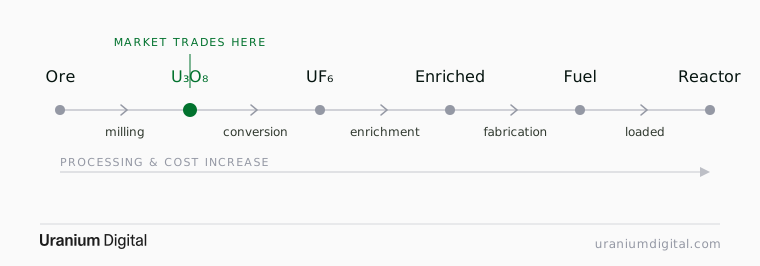
Yellowcake is the starting point of the nuclear fuel cycle, the raw commodity that everything downstream is built on. To become fuel, U₃O₈ is first converted into uranium hexafluoride (UF₆), then enriched to raise the share of the fissile isotope uranium-235, and then fabricated into fuel assemblies for reactors. Because conversion, enrichment, and fabrication each add cost and processing, yellowcake is the cheapest and most liquid point in the chain, which is why it is where the market trades. For how the material moves from powder to gas, see uranium conversion.
How yellowcake is traded and priced
Yellowcake trades as a physical commodity, quoted in U.S. dollars per pound of U₃O₈. Historically it has changed hands over the counter, through bilateral contracts negotiated by phone and email, which is one reason uranium pricing is less transparent than oil or metals. A published spot price reflects broker assessments of recent deals rather than a live, executable market. For the full picture of how the market works, see how uranium is traded today, and for why so little uranium trades relative to the physical stock, see the uranium financialization gap.
Yellowcake on Uranium Digital
On Uranium Digital, yellowcake is the commodity behind every digital warehouse receipt. Each receipt represents one pound of U₃O₈ and is backed 1:1 by physical U₃O₈ held at ConverDyn, an accredited U.S. conversion facility. Reserves are independently audited, and receipts are redeemable for physical delivery by qualified institutions. Institutions trade receipts on-screen and move between yellowcake and receipts through physical settlement. See what a digital warehouse receipt is.
FAQ
Yellowcake is made of triuranium octoxide (U₃O₈), a uranium oxide compound that is roughly 70 to 90 percent uranium by weight. It is produced by milling mined uranium ore into a concentrated powder, with the remaining content being oxygen and small amounts of other compounds left from processing. Yellowcake is the purified, tradable form of uranium before conversion and enrichment.
Yellowcake is only weakly radioactive and is handled with standard industrial safety controls rather than heavy shielding. U₃O₈ emits mostly alpha radiation, which does not penetrate skin, so the main precaution is against inhaling or ingesting the powder rather than external exposure. It is not fissile in this form and cannot sustain a nuclear chain reaction. Reactor-grade and weapons-grade material are produced only after enrichment, a later and tightly controlled step.
Yes, in practice yellowcake and U₃O₈ refer to the same material. Yellowcake is the industry name for the powder a uranium mill produces, and U₃O₈ (triuranium octoxide) is the chemical compound it is measured and priced against. Uranium contracts quote pounds of U₃O₈ even though the material delivered is yellowcake.
The price of yellowcake is quoted in U.S. dollars per pound of U₃O₈ and has traditionally been set through private, over-the-counter contracts rather than a public exchange. Because most deals are bilateral, published spot prices are broker assessments of recent activity rather than live executed prices, which is a core reason uranium pricing is less transparent than other major commodities.
Yellowcake is unenriched uranium, while enriched uranium has had its concentration of the fissile isotope uranium-235 increased. Natural yellowcake contains about 0.7 percent uranium-235, but most reactors need 3 to 5 percent, which is achieved through conversion to UF₆ and then enrichment. Yellowcake is the traded commodity, while enriched uranium is a downstream, more tightly regulated product.