The financialization gap in uranium markets
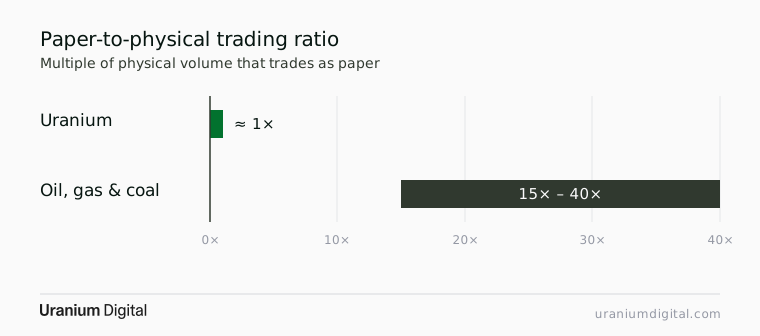
Uranium trades roughly 1:1 paper-to-physical, while oil, gas, and coal trade at 15 to 40 times. What the financialization gap is and what causes it.
Uranium trades at roughly 1:1 paper-to-physical. Oil, gas, and coal trade at 15 to 40 times their physical volume. That difference is the financialization gap, the amount of financial trading that sits on top of physical trade in other energy commodities, and is largely absent in uranium.
What paper-to-physical means
The paper-to-physical ratio compares the volume of financial contracts traded on a commodity with the volume of the physical commodity that changes hands. Futures, options, swaps, and index products all count as paper. A ratio well above 1 means most trading is financial. Producers and consumers hedge, funds take positions, and market makers provide liquidity, with only a fraction of contracts ending in physical delivery.
What the financial layer does in other commodities
In oil, gas, and metals, the financial layer performs three functions.
- Hedging. Producers lock in sale prices and consumers lock in costs, months or years ahead.
- Price discovery. Continuous trading on exchanges produces executed prices that the whole market can see.
- Liquidity. Market makers and financial participants are on both sides of the market, so physical participants can trade in size without moving the price.
These functions rest on a reference price drawn from executed trades. Oil contracts reference benchmarks such as Brent and WTI. Base metals reference prices set on the London Metal Exchange.
Why uranium trades near 1:1
Uranium has had no executable venue, no benchmark drawn from executed trades, and no regulated derivatives market of any depth. Its spot price is an assessment published by pricing agencies. Exchange-listed uranium futures exist, but they are cash-settled against that assessment and trade thinly.
Without a venue and a reference price built from executed trades, hedging instruments have little to anchor to, and most financial participants have no way in. Trading volume stays close to the volume of physical material that changes hands, which is negotiated bilaterally over the counter.
What the gap means for institutions
For institutions, the gap shows up as missing tools. A utility has limited means to hedge fuel costs with an exchange-traded instrument. A fund that wants exposure to the uranium price has to accept the indirect routes described in how institutions get uranium exposure. A producer sells mostly through private term contracts at prices the rest of the market does not see.
Demand for the commodity is rising. Utilities, governments, and AI-driven power demand are converging on nuclear, as covered in the nuclear renaissance and AI power demand. The market that supplies that demand still trades by phone and email.
Where the financial layer starts
Financial markets in a commodity are built on executed prices, and executed prices come from a venue with physical settlement. Uranium Digital operates a live spot order book where cash and physical traders transact in one venue, with trades settled through digital warehouse receipts backed 1:1 by physical U₃O₈ held at an accredited U.S. conversion facility. Institutions issue and redeem between physical uranium and receipts through physical settlement. See physical versus cash settlement for why the physical path comes first. This is analytical commentary, not investment advice.
FAQ
The financialization gap is the difference between how much financial trading happens relative to physical trade in uranium versus other energy commodities. Uranium trades at roughly 1:1 paper-to-physical, while oil, gas, and coal trade at 15 to 40 times their physical volume. The gap reflects the absence of an executable venue, a benchmark drawn from executed trades, and a deep derivatives market in uranium.
The paper-to-physical ratio compares the volume of financial contracts traded on a commodity, such as futures, options, and swaps, with the volume of the physical commodity that changes hands. A high ratio means most trading is financial, used for hedging, price discovery, and liquidity. A ratio near 1, as in uranium, means trading is close to the physical volume alone.
Uranium trades near 1:1 because it lacks the financial layer that multiplies trading in other commodities. There has been no executable venue and no benchmark drawn from executed trades, and exchange-listed uranium futures are cash-settled against an assessed price and trade thinly. Without those foundations, trading volume stays close to the volume of physical material that changes hands.
Yes, but they are a small market. CME Group lists a cash-settled U₃O₈ futures contract based on a UxC price assessment, and it trades thinly. Because the contract settles against an assessment rather than executed trades, it has not developed into the deep hedging market that oil, gas, and metals futures provide.