The nuclear fuel cycle, explained
The nuclear fuel cycle is the path uranium takes from mined ore to reactor fuel and spent fuel. The stages of the fuel cycle, and where uranium is traded.
The nuclear fuel cycle is the sequence of steps that turns uranium in the ground into fuel for a reactor, and then manages what is left after the fuel is used. The early steps, known as the front end, are where uranium exists as a traded commodity. Each step changes the physical or chemical form of the uranium and adds cost, which is why the market concentrates at the cheapest and most liquid point, yellowcake, rather than at finished fuel.
The front end, step by step
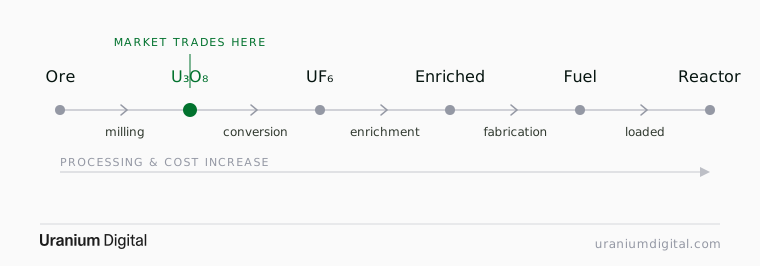
The front end of the fuel cycle takes uranium from ore to a fuel assembly through five stages.
- Mining. Uranium ore is extracted from the ground, either by conventional mining or by in-situ recovery, which dissolves uranium out of the rock underground. See where uranium comes from.
- Milling. The ore is processed into U₃O₈, a concentrated uranium powder known as yellowcake. This is the form in which uranium is bought and sold, and the point at which the material becomes a tradable commodity.
- Conversion. Yellowcake is chemically converted into uranium hexafluoride (UF₆), the form required for enrichment. See uranium conversion.
- Enrichment. The share of the fissile isotope uranium-235 is raised from its natural level of about 0.7 percent to the 3 to 5 percent most reactors need. See enriched uranium.
- Fabrication. Enriched uranium is converted into a ceramic powder, pressed into pellets, and sealed into fuel rods that are bundled into the assemblies loaded into a reactor. See fuel fabrication.
Why the market sits at yellowcake
Each stage after milling adds processing, cost, and regulation, so uranium is most liquid at the yellowcake stage. A pound of U₃O₈ is a stable, well-defined unit that any participant in the market can hold, store at a conversion facility, and transfer. Conversion, enrichment, and fabrication are then priced as separate services layered on top of the uranium itself. This is why the uranium spot price is quoted per pound of U₃O₈, and why the front end of the cycle is where financial participants engage with the market.
The three cost components of reactor fuel
The delivered cost of nuclear fuel is built from three distinct, separately traded inputs.
- Uranium, priced per pound of U₃O₈.
- Conversion, the service that turns U₃O₈ into UF₆.
- Enrichment, priced in separative work units (SWU).
Because these trade independently, a utility can manage each one separately, and the markets for feed, conversion, and enrichment each have their own supply, demand, and pricing dynamics.
The back end
After several years in a reactor, fuel is removed as spent fuel. Depending on national policy, it is stored, reprocessed to recover usable material, or placed in long-term disposal. The back end sits outside the uranium commodity market, which is concentrated in the front end where uranium trades.
Where Uranium Digital sits
Uranium Digital operates at the front end of the fuel cycle, where uranium trades as a commodity. Physical U₃O₈ is held at an accredited U.S. conversion facility, and represented by digital warehouse receipts that institutions trade on-screen and redeem through physical settlement. For how that market works today, see how uranium is traded today.
FAQ
The five stages of the front end of the nuclear fuel cycle are mining, milling, conversion, enrichment, and fabrication. Mining and milling produce yellowcake (U₃O₈), conversion turns it into uranium hexafluoride (UF₆), enrichment raises the concentration of uranium-235, and fabrication forms the enriched uranium into reactor fuel. The back end then manages spent fuel through storage, reprocessing, or disposal.
Uranium is traded as a commodity at the milling stage, in the form of U₃O₈ or yellowcake. This is the point where the material becomes a stable, standardized product that can be stored and transferred, and it is the cheapest and most liquid stage of the cycle. Conversion and enrichment are traded separately as services rather than as the commodity itself.
The front end covers everything from mining the uranium to fabricating it into fresh reactor fuel, and it is where uranium exists as a traded commodity. The back end covers what happens after fuel is used, including spent-fuel storage, reprocessing, and disposal. The uranium market and its trading infrastructure sit almost entirely in the front end.
The front-end steps from mining through fabrication typically take many months, because conversion, enrichment, and fabrication are sequential industrial processes carried out at a small number of specialized facilities. Fuel then remains in a reactor for several years before it is removed as spent fuel, so the full cycle from mine to spent fuel spans years rather than weeks.