Where uranium comes from
Uranium is found in ore deposits worldwide and mined in a few countries, led by Kazakhstan. Where uranium is found, how it is mined, and who produces it.
Uranium is a naturally occurring element found in rock throughout the earth's crust. It is mined from concentrated ore deposits and processed into yellowcake (U₃O₈), the form in which it is traded. Production is concentrated in a small number of countries and mines, which shapes how the uranium market behaves.
Where uranium is found
Uranium is present in most rocks and soils and in seawater, but at very low concentrations. It is more common in the earth's crust than silver or mercury. Mining is economic only where geological processes have concentrated it into ore deposits.
Deposits vary widely in grade, the percentage of uranium in the rock. There are three main deposit types.
- Unconformity deposits, such as those in Canada's Athabasca Basin in Saskatchewan, which host some of the highest-grade uranium mines in the world.
- Sandstone deposits, common in Kazakhstan and the United States, which are often suited to in-situ recovery.
- Large polymetallic deposits, such as Olympic Dam in South Australia, where uranium is recovered alongside copper and gold.
Australia holds the largest identified uranium resources of any country. Kazakhstan and Canada also hold large resources and lead global production.
How uranium mining works
Uranium is extracted by three main methods.
- In-situ recovery (ISR) dissolves uranium out of the ore underground by circulating a solution through it, then pumps the uranium-bearing liquid to the surface. It is now the most common method worldwide.
- Open-pit mining is used for deposits near the surface.
- Underground mining is used for deeper deposits, including most of the high-grade Athabasca Basin mines.
After extraction, the ore or solution is processed at a mill into U₃O₈. Milling near the mine means only the concentrated uranium, and not tonnes of waste rock, has to be shipped and sold.
From mine to market
Milling crushes the ore and leaches the uranium out with acid or alkaline solutions. For in-situ recovery, the uranium-bearing solution goes straight to processing. In both cases the uranium is then precipitated, dried, and packed into steel drums as U₃O₈ concentrate, typically 70 to 90 percent uranium by weight.
The drums are shipped to a conversion facility, where the U₃O₈ is credited to the owner's account. From that point, the uranium can be sold by book transfer without being moved again. This is the form in which uranium is priced and traded. See uranium conversion for the next processing step.
Secondary sources of supply
Mining is not the only source. Secondary supply comes from inventories held by governments, utilities, and producers, such as from re-enrichment of depleted uranium. Mine production has not always covered reactor demand on its own, so secondary supply has filled the difference, and changes in it affect the market as much as changes in mining.
Which countries produce uranium
Global uranium production is concentrated in a few countries. Kazakhstan is the largest producer, accounting for roughly 40 percent of world output, mostly through in-situ recovery. Canada and Australia are the other major producers. Namibia, Uzbekistan, Niger, and Russia account for most of the remainder.
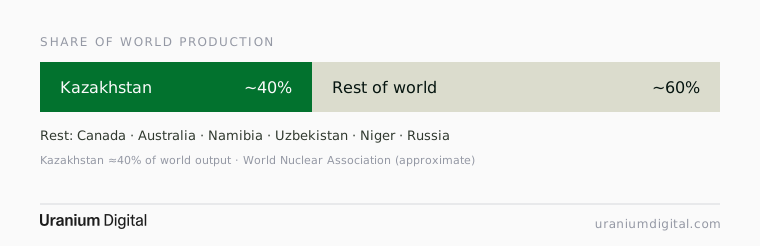
A supply base that depends on a few countries and a small number of large mines is exposed to disruption. Supply concentration is one of the factors that moves uranium prices, and one reason utilities secure supply through long-term contracts. For how the material then trades, see how uranium is traded today and the nuclear fuel cycle.
FAQ
Uranium is a naturally occurring element mined from concentrated ore deposits in the earth's crust, then processed into yellowcake (U₃O₈) for trading. It is extracted by in-situ recovery, open-pit, or underground mining, depending on the deposit. Most of the world's uranium comes from a small number of countries, with Kazakhstan the largest producer.
Uranium is found in rocks, soils, and seawater worldwide, but mining is economic only in concentrated ore deposits. The largest identified resources are in Australia, Kazakhstan, and Canada. Canada's Athabasca Basin hosts some of the highest-grade deposits in the world.
Kazakhstan produces the most uranium, accounting for roughly 40 percent of global output, mostly through in-situ recovery. Canada and Australia are the next largest producers. Because production is concentrated in a few countries, uranium supply is exposed to disruption, which affects prices and long-term contracting.
Uranium is mined by in-situ recovery, which dissolves uranium out of the ore underground and pumps it to the surface, by open-pit mining for shallow deposits, and by underground mining for deeper ones. In-situ recovery is now the most common method worldwide. After extraction, the uranium is milled into yellowcake near the mine.